Zampanò–female readers relationship
House of LeavesThe Zampanò–female readers relationship joins physical dependence to intellectual appetite and emotional substitution. Because Zampanò was blind, women entered his apartment to read aloud, yet the arrangement was never merely technical: he selected voices, praised particular readings, disclosed fragments of old grief, and described women’s speech as his greatest comfort. The readers could not fully possess him, but their voices made possible the immense verbal world he continued constructing until the day before his death.
Practical Arrangement and Daily Dependence
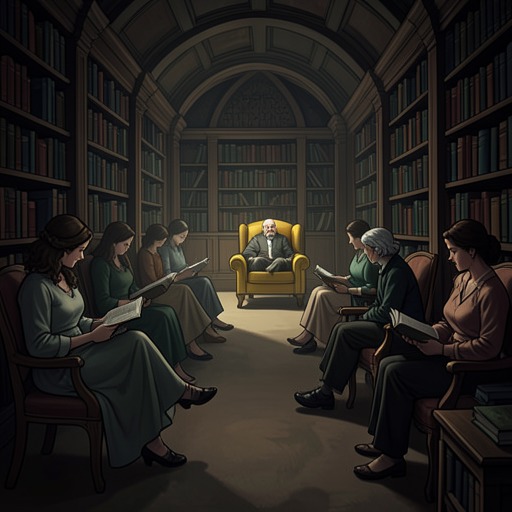
Almost half of Zampanò’s books were in Braille, but Braille did not eliminate his need for other readers. Over the years, numerous women visited him during the day, arriving through community centers, the Braille Institute, or volunteer programs at the University of Southern California, the University of California, Los Angeles, and Santa Monica College. Their work gave him access to texts that he could not independently see, while the sheer number of readers suggests a continuing social system rather than a single helper or isolated accommodation.
The arrangement remained intimate without becoming familiar. People who read to Zampanò generally did not claim to know him well; they left with impressions rather than a stable biography. One student considered him certifiably mad, while an actress who had spent a summer reading to him thought him a romantic. These conflicting judgments reveal how the relationship exposed different surfaces of the same man: an austere, secluded figure to some, and a person whose literary and emotional life remained intensely charged to others.
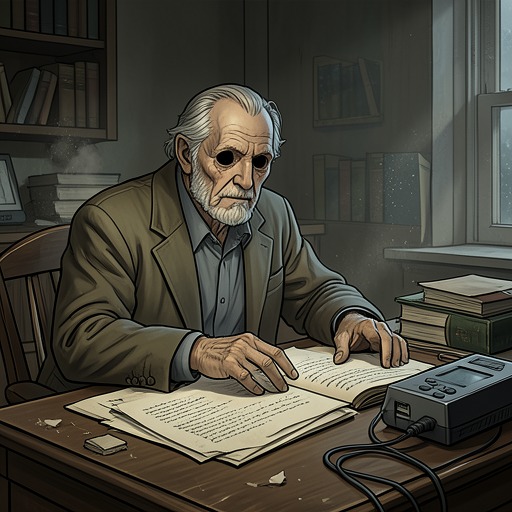
The readers’ presence also contrasted with the strict routine surrounding Zampanò’s apartment. He appeared every morning and evening to walk the courtyard among its knee-high weeds and more than eighty stray cats, yet inside he lived without clocks, unused candles, or much electric light. The women who entered that dark, timeless space brought not only books but an audible form of orientation. Their voices performed the access that the apartment’s objects could not provide.
Voice as Comfort and Emotional Access
Zampanò openly acknowledged that the female readers were not an accidental feature of his working life. He stated, “there is no greater comfort in my life than those soothing tones cradled in a woman’s words.” The remark makes the relationship bodily as well as literary: words arrive not as silent information but as tones, held and cradled by another person’s voice. Reading therefore becomes a form of auditory shelter, one that answers both his blindness and his solitude.
His dependence was not limited to the content of what women read. He valued the manner of delivery, as shown by Amber Rightacre’s account of his insistence that she read Tolstoy. He told her that she read Tolstoy better than anyone else, partly because she could manage the French passages through her Canadian background. His praise recognizes a specific skill, but it also turns reading into a personal bond: Amber’s linguistic competence made her voice uniquely desirable to him.
Amber described Zampanò as “imperceivable and alone, though not I think so lonely.” The distinction is important. He was difficult to grasp and apparently isolated, but the readers’ repeated visits prevented isolation from becoming complete loneliness. Their voices entered the apartment as temporary companionship, even when the relationship stopped short of mutual knowledge. The reader could approach him through language without ever receiving a fully accessible self in return.
Grief, Desire, and the Limits of Intimacy
The readers sometimes encountered emotional crises that had little obvious connection to the assigned book. An actress once found Zampanò in what she called “a terrible way.” She initially assumed he was drunk, but he neither drank nor smoked and lived an austere life. Instead, he was deeply depressed, crying and asking her to leave; after she made him tea, he explained the episode as heart trouble and called it “old heart-ache matters.” The scene turns the reader from a conduit for literature into an unwilling witness and caretaker.
Zampanò’s grief remained deliberately incomplete. He never told the actress who had caused it, and later he sometimes mentioned seven names—Beatrice, Gabrielle, Anne-Marie, Dominique, Eliane, Isabelle, and Claudine—when he became disconsolate and seemed to return to a dark, tangled period. The women readers thus occupied an unstable position beside an absent or concealed romantic history. They received traces of desire without receiving its definitive story.
His interest in women also exceeded the immediate requirements of blindness. The account explicitly rejects coincidence as an explanation for the fact that all his readers were female. The reading arrangement offered him access to literature, but it also placed him in sustained contact with women’s voices and bodies, with the possibility of attraction, admiration, and emotional projection. The relationship therefore combines care with asymmetry: the women give time, labor, and vocal presence, while Zampanò controls what he reveals and what remains inaccessible.
Amber Rightacre and the Inheritance of Voice
Amber Rightacre provides the clearest surviving portrait of this relationship. After Johnny Truant found Zampanò’s notebooks and a notepad containing the names and telephone numbers of more than a hundred readers, he contacted several women and reached Amber. She agreed to meet him for a drink, carrying with her a personal account unavailable in the manuscript’s impersonal accumulation of notes.
Amber’s own description emphasizes both contact and distance. She remembered Zampanò’s jokes about his lack of education, his claim that he had never attended high school, and his habit of making their exchange into a contest in which he declared that her lack of schooling made him smarter than her. Yet most of their time was spent with her reading to him. The teasing gave the sessions a conversational surface, while Tolstoy supplied their principal shared activity.
When Amber later told Johnny that Zampanò had said he had no children “any more,” he immediately complicated the statement by adding, “Of course, you’re all my children.” She was the only person present, but he looked at her as though the small apartment were full of faces he could see and address. The remark transforms the readers into a dispersed family, though it also exposes the strangeness of the role: each woman may be individually present while being absorbed into a collective imagined by Zampanò.
Amber consequently becomes more than a witness to his habits. She is a bridge between Zampanò’s private practice and Johnny’s attempt to reconstruct it. Through her, the relationship appears not as a list of services but as a chain of transmitted voices: Zampanò dictated and composed, Amber read and remembered, and Johnny gathered her testimony while trying to determine what the old man had left behind.
Readers, Authorship, and the Unfinished Work
Zampanò’s dependence on readers extended into composition itself. He was a graphomaniac who scribbled until he died, repeatedly revising, restructuring, and dictating long passages. The day before he disappeared from his courtyard, he was still amending pages and reorganizing a chapter of the work he called his masterpiece or precious darling. His readers therefore did not merely unlock existing books; they helped sustain the auditory and intellectual conditions in which his own writing could continue.
The account of Maus Fife-Harris clarifies how far this collaboration could reach. Fife-Harris, a doctoral candidate in comparative literature at the University of California, Irvine, objected when Zampanò asked her to write down large narrative passages that seemed inappropriate for a critical work. He dismissed her objections with a joke about doctors and a freshman, then continued pressing forward. Her resistance shows that the readers were sometimes scribes as well as listeners, forced to negotiate the boundary between transcription and authorship.
This boundary is especially unstable because Zampanò never finished the work his readers helped make possible. His blindness is not presented simply as a problem awaiting correction; it organizes a social technology of reading, dictation, memory, and voice. The women’s labor becomes part of the work’s material history, even though the finished object cannot clearly assign each contribution or preserve the circumstances in which it was produced. The relationship thus exposes authorship as dependent on bodies and voices that the final text can obscure.
The relationship also prepares the larger book’s recurring concern with unreliable transmission. Johnny inherits fragments, telephone numbers, recollections, and dictated material rather than a secure authorial explanation. Each female reader supplies access while also introducing uncertainty, because no single account can recover Zampanò completely. His life survives through a chorus of partial witnesses, and the same voices that make his writing possible ensure that it reaches later readers indirectly, through layers of selection, recollection, and interpretation.